For most of us, flying is a passive experience. We board a plane, settle into our seats, and entrust our journey to a highly trained crew in the cockpit. We are passengers, watching the world shrink below as a disembodied voice provides updates from the flight deck. But for a select few, the allure of the sky is more than just a means to an end; it’s a calling. They dream of taking the controls, feeling the power of the engine, and experiencing the world from a new, exhilarating perspective. To these budding pilots, the initial flight lesson is a life changing experience, an exhilarating process that turns them into an active component in the wonder of flight, versus the inanimate object of the passenger.
This article is for those who are ready to take that step. We will demystify the first flight lessons Florida, breaking down what to expect and reassuring you that it is an accessible, exciting, and profoundly rewarding experience. It’s a journey that begins long before you even lift off the runway.
The Pre-Flight Inspection: Becoming One with the Aircraft
After the briefing, it’s time to head out to the tarmac for the pre-flight inspection, or “walkaround.” This is a pilot’s ritual, a meticulous check of the aircraft before every flight. Your instructor will involve you in this process, showing you how to inspect the wings, ailerons, flaps, landing gear, and engine components.
You’ll learn to check fuel levels, examine tire pressure, and look for any signs of damage or leaks. This walkaround is a tactile and visual introduction to the aircraft, solidifying the knowledge you gained in the briefing. It’s a moment of accountability and partnership, teaching you the importance of being responsible for the machine that will carry you into the sky. This is where the journey from passenger to pilot truly begins to feel real.
Taking Your Seat: The Cockpit Experience
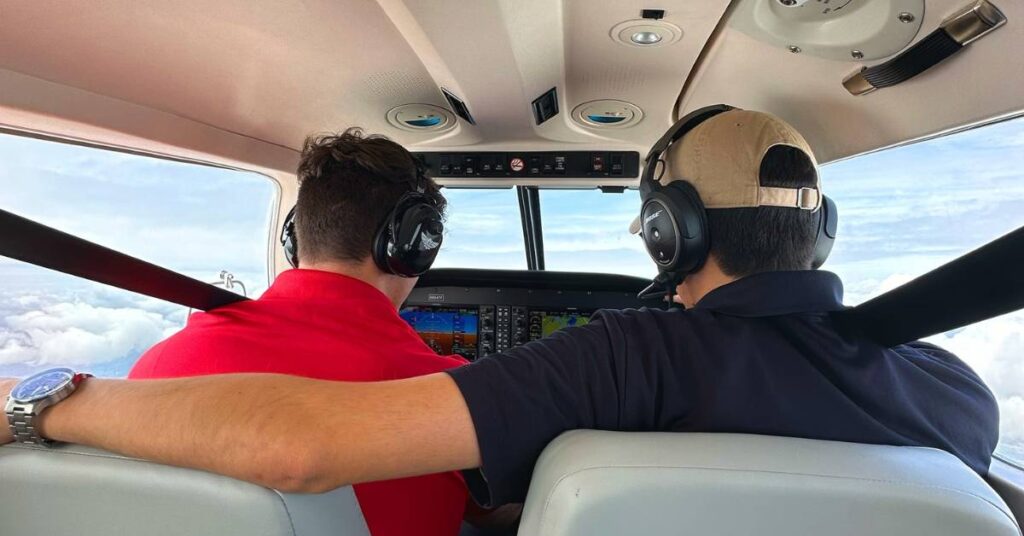
After the walkaround is finished you’ll enter the cockpit for a detailed briefing to understand normal gear-up and gear-down procedures, learn about critical control circuit limitations and become familiar with clearing procedures for intercept scenarios. Don’t be surprised if the space feels smaller and more cluttered than you imagined. Your instructor will demonstrate how to fasten the seat belt, and he or she will perform a checklist of instruments and controls. You will sit in the left hand pilot seat, the usual pilot seat. Your instructor will be in the right, with their own set of controls, ready to assist or take over at any moment.
As you look out over the instrument panel, the array of dials and gauges might seem overwhelming. But your instructor will point out the most important ones for your first flight: the airspeed indicator, the altimeter, and the heading indicator. They will guide you through the process of starting the engine and communicating with air traffic control for taxiing instructions. This is often the most exhilarating part of the ground portion – hearing your instructor’s professional communication and knowing you’re about to be part of it.
The Moment of Liftoff: You’re in Control
As you taxi to the runway and receive clearance for takeoff, your heart will likely be racing. Your instructor will handle the initial takeoff, but once you’re safely climbing away from the ground, they’ll hand the controls over to you.
It cannot be described how it felt to grip the yoke when you were taking it the first time. It is not a steering wheel; it is something to operate the entire machine. You’ll feel the subtle pressure of the air and the plane’s response to your slightest movements. Your instructor will guide you on how to maintain a straight and level flight path, how to make gentle turns, and how to control your altitude. The feeling of being in command of this incredible machine is a moment of pure freedom. The world, which you’ve only ever seen from a window seat, now unfolds before you with stunning clarity, a mosaic of roads, fields, and buildings.
The Landing and Debriefing: Reflection and Future Plans
After about an hour in the air, your instructor will take over the controls for the landing, a more complex maneuver that requires greater skill. Upon landing and pulling the craft back to the hanger you will experience a sense of great accomplishment.
Back on the ground, your instructor will conduct a post-flight debriefing. They will ask you what you enjoyed, what you found challenging, and answer any lingering questions. They’ll provide honest feedback on your performance and explain the next steps should you decide to continue your flight training. This final conversation is an important opportunity to reflect on your experience and solidify your new passion for flight.
The first flight lesson is more than just an hour in the sky. It’s a transformative experience that challenges your perceptions and opens up a world of possibility. It proves that with the right guidance, the dream of flying is not just for a select few. It’s for anyone with the courage to take a step out of the passenger seat and into the pilot’s. It is the start of an adventure when the sky would not be a ceiling anymore, but a newer horizon to explore.
About the Author